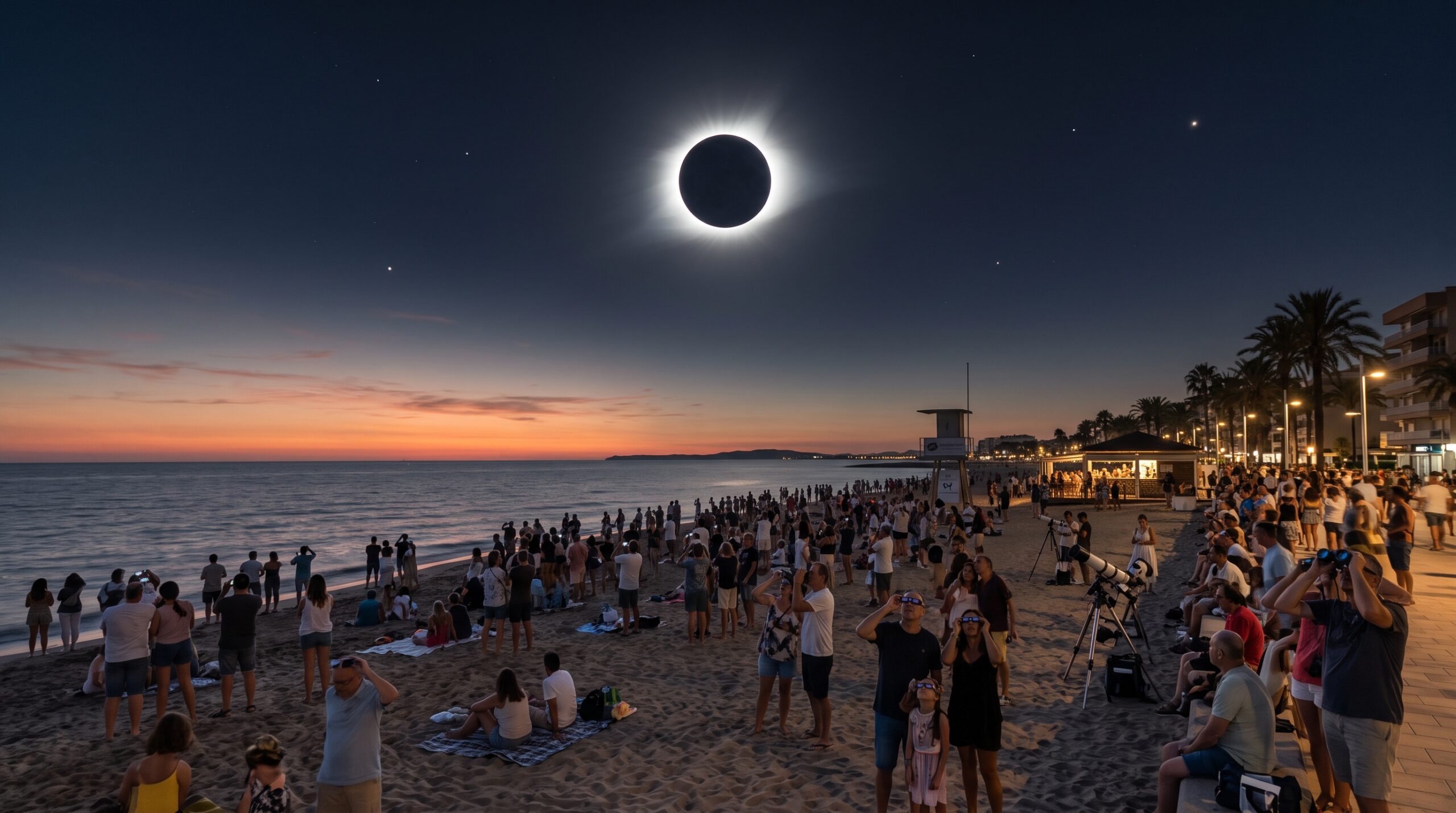
On 12 August 2026, the Region of Valencia was one of Spain's best vantage points for a total solar eclipse at sunset, with the sun sinking low over the sea
The total solar eclipse of 12 August 2026 was one of the great astronomical events Spain has seen in decades, and the Region of Valencia had a front-row seat. The path of totality crossed the peninsula from north-west to south-east, from Luarca in Asturias to the coast of Castellón, ending over the Mediterranean shortly before sunset. For visitors from the UK and Ireland who watched it live, or who are already curious about the next eclipses to cross Spain, here is a recap with the key facts.
Castellón and northern Valencia, inside the path of totality
Castellón and the northern half of Valencia province fell inside the path of totality, the privileged zone from which the solar corona could be seen with the naked eye for a few seconds. Towns such as Peñíscola, Benicàssim, Castellón de la Plana and Morella, along with other spots on the Costa del Azahar, experienced full darkness in the middle of sunset. The regional government set up eight official viewing points across the region, including Castellón de la Plana, Benassal and Peñíscola.
Valencia city: a brief totality with the sun very low
The city of Valencia also fell inside the path of totality, though for a much shorter time than Castellón: around a minute, with the sun only a few degrees above the western horizon. The partial phase began around 7.30pm, with the moment of maximum darkness around 8.30-8.32pm, shortly before sunset. The city council set up its main viewing area on a stretch of the Malvarrosa and Cabanyal beaches, and also recommended terraces, balconies and rooftops with a clear view to the west.
Alicante: a very deep partial eclipse
Alicante fell outside the path of totality but experienced a partial eclipse of great magnitude, with enough of the sun obscured to cause a noticeable dimming of the sky in the middle of sunset, without reaching full darkness.
How to watch it safely
Throughout the partial phase, both before and after totality, the official advice was to look at the sun only through certified eclipse glasses meeting the ISO 12312-2 standard and bearing the CE mark, or through approved solar filters on binoculars and telescopes. Only during the exact seconds of totality, and only within the band where it occurred, was it safe to look directly without a filter.
A joint campaign with Airbnb and Valencian tourism
ApturCV, Airbnb and Turismo Comunitat Valenciana coordinated a responsible-tourism campaign ahead of the eclipse, with a practical guide distributed to 3,000 holiday-rental hosts in Spanish and English. The guide covered safety guidance for guests, precautions against wildfire risk during an August under maximum alert, and recommendations for supporting local shops and restaurants in the towns within the path of totality.
A record August for holiday accommodation
The interest drove exceptional demand: Airbnb searches for those dates rose by more than 250% year on year, with four to five times more bookings from foreign travellers than from Spanish ones. An estimated 75,000 extra visitors stayed in rural accommodation across Spain, generating around €130 million in tourist spending in under a week, more than a third of the eclipse's total national impact.
What's left for those who missed it
12 August 2026 was the first of three eclipses known as the "Iberian Trio", which will cross Spain again in the coming years. Anyone who missed it, or simply wants to relive the experience, already has another date with the Valencian sky.
Frequently asked questions
Where was the eclipse total in the Region of Valencia?
In Castellón and the northern half of Valencia province, including Valencia city with a very brief totality. Alicante experienced a very deep partial eclipse, without reaching full darkness.
How long did totality last?
It varied by exact location: around a minute in Valencia city and slightly longer further north towards Castellón, always with the sun very low at sunset.
Was it safe to look at the eclipse without protection?
Only during the exact seconds of totality, and only within the band where it occurred. The rest of the time, certified ISO 12312-2 eclipse glasses with the CE mark were essential.
If you're coming to the Region of Valencia for an event like this, or simply on holiday, travel with confidence: choose a legal holiday rental with a registration number. We explain how to spot one in
our guide to legal holiday rentals.